
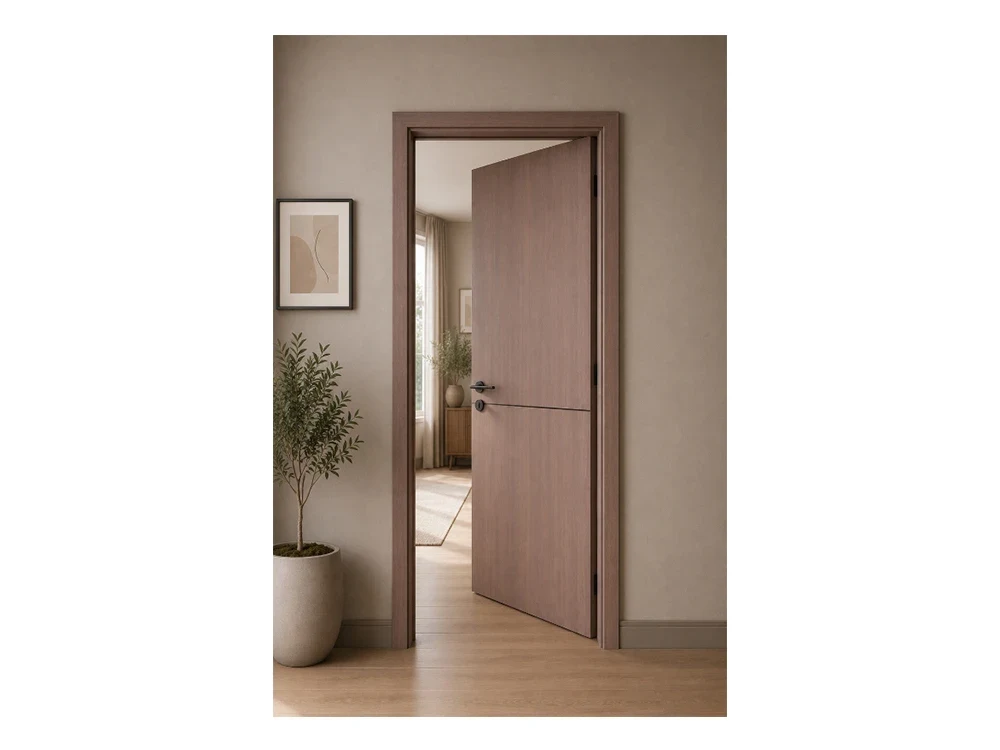

Oak is the default upgrade from a hollow white door, and for good reason: it has visible grain, it takes a knock without showing it, and it suits both period and modern rooms. The decisions that actually matter are solid versus veneered, and whether the door arrives finished or needs oiling once it is hung.
Solid oak or oak veneer?
Veneered oak is a real oak surface over an engineered core. Solid oak is oak all the way through. Veneer is more stable in an Irish house, and most oak doors sold here are veneered.
Timber moves with moisture, and a solid oak door in a hallway that goes from damp to heated and back will move more than an engineered one. That movement is what makes a door start catching on the frame in winter and swinging free in summer.
An engineered core with an oak veneer face gives you the same look with far less movement. Solid oak still has its place, particularly where a door is thick and heavy by design, but it is not automatically the better door.
Prefinished or unfinished?
Prefinished doors arrive sealed and ready to hang. Unfinished doors need oiling or lacquering after they are hung, usually two or three coats.
Prefinished is the practical choice for most jobs: consistent finish, no drying time, no smell through the house. Unfinished makes sense when you want a specific stain or oil, or when the doors need to match existing joinery exactly.
One thing worth knowing about unfinished doors: the top and bottom edges need sealing as well as the faces. Skipping them is the most common cause of a door taking up moisture and swelling.
What about glazed oak doors?
Glazed oak doors bring light through a hall or into a back room while keeping the door itself solid oak.
A hallway with no window is the classic case. Putting glazed doors on the rooms either side borrows light from them without opening the space up structurally. The glass is toughened safety glass to CE standard.
Frosted or reeded glass gives the light without the sightline, which is what most people want between a hall and a living room. There is more on the options on our <a href="/internal-doors/glass/">glazed internal doors</a> page.
How are they hung?
Measured to the existing openings, trimmed to fit, hung on three hinges and adjusted so they close cleanly.
Older Irish houses rarely have square openings, and that is the whole job. Doors are trimmed to the opening rather than the opening being made to suit the door, and the hinge positions are set so the door hangs true in a frame that may not be.
Handles, latches and any hinge upgrade are specified with the door so everything arrives together.
Everything we supply and fit carries a ten year warranty against defects.
How it works
We call out, measure the space and talk through what you want. Our designers draw it in 3D so you see the finished piece in your own room, and you get one complete itemised quote within two working days. Nothing is ordered and nothing is charged until you say yes.
One team for this and the rest of the job
The same team that makes this fits it, and we also do kitchens, fitted wardrobes, internal doors and windows. If more than one thing needs doing, it is one contractor, one schedule and one point of contact rather than four. See the rest of our work.
Frequently asked questions
Will oak doors match my existing skirting?
Oak varies in tone between batches and suppliers. If matching existing joinery matters, we bring samples to the measure so you can see them in your own light.
Do you take the old doors away?
Yes, removal and disposal of the old doors is part of the job.
Can you rehang doors into existing frames?
Yes, that is the usual job. New frames are only needed where the existing ones are damaged or the opening size is changing.
What areas do you cover?
Dublin, Meath, Kildare and Wicklow. The design visit is free and there is no obligation.