
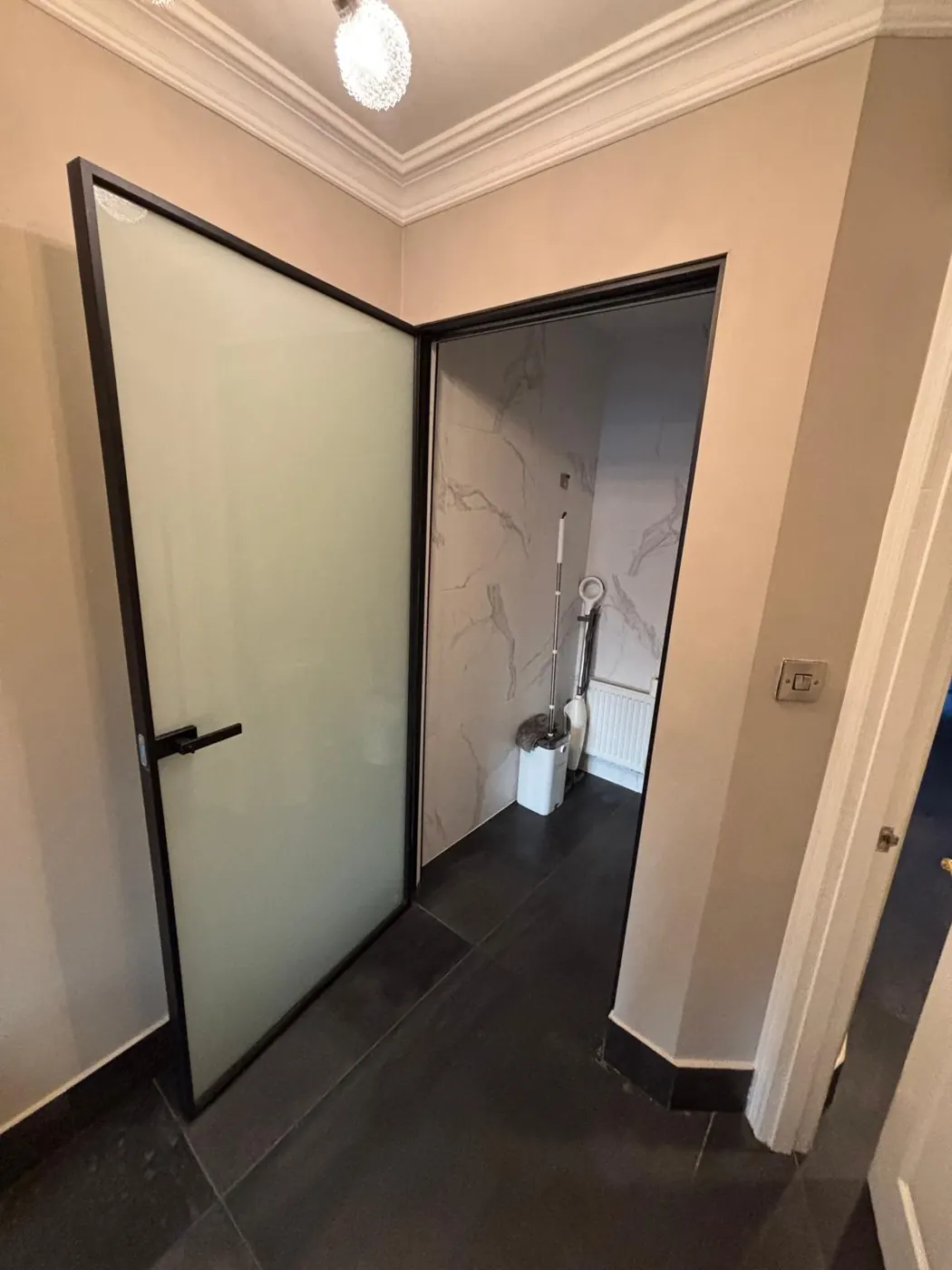
If you are looking for internal doors in Dublin, supplied and fitted by one team rather than bought in one place and hung by someone else, this page explains how we do it. The Home Upgrade Co supplies and fits internal doors across Dublin and surrounding counties. Stephen measures every opening in your home, you get a 3D design and a full quote within 2 working days, and our own fitters hang the doors. Oak, painted, panel, flush and glazed doors, fitted to existing frames where the frames are sound, new frames where they are not.
How it works
Three steps, and the first one costs nothing.
- Free in-home measure. Stephen visits, measures every doorway, checks the existing frames and talks through styles with you. No obligation.
- 3D design and quote within 2 working days. You see the doors in your rooms before you commit, with one complete price for the whole job.
- Fitted within 12 weeks of sign-off. Our own team supplies and fits the doors, hardware and any frame work, and takes the old doors away.
What does a supply and fit quote include?
A complete supply and fit quote lists the doors, handles and hinges, fitting labour, any frame or architrave work needed, and removal of old doors.
Quotes for internal doors vary wildly online, and most of the difference is not the doors. One quote is for the door leaf only. Another is for the door, the frame, the architrave, the handles, the hinges, the fitting and taking the old doors away. Both might be called "internal doors supplied and fitted", and you cannot compare them until you know what is inside each one.
Our quote lists every part of the job so there is nothing to add later: each door by room, the core type and finish, the handles, latches and hinges, whether the existing frame is being kept or replaced, any new architrave or stops, the fitting, and disposal of the old doors. If a frame needs work, that is written down before you sign, not discovered on the day.
When you are comparing internal door fitters in Dublin, ask each one the same question: what happens if a frame turns out to be out of square? The answer tells you whether the quote is complete.
What our quote does not include is just as clear: we do not paint primed doors on site, we do not quote for a door leaf on its own, and we do not add extras after the measure. If a frame needs replacing, it is on the quote before you sign.
Every door we supply and fit is covered by our 10-year warranty on doors and windows, and the warranty is written on your quote.
How much do internal doors cost in Dublin?
Internal door costs vary with door count, style, core type and frame condition, which is why every quote starts with a free in-home measure.
We do not publish prices, and we do not quote from a photo or a phone call, because the number depends on things that can only be checked on site. How many doors. Whether they are hollow, semi-solid or solid core. Whether you want painted, oak or glazed. Whether the existing frames are square and sound, or need to be replaced. Two houses with the same number of doors can need very different amounts of work, and a figure typed into a website cannot know which house is yours.
What we can tell you is what happens before any money changes hands. Stephen calls out, measures every opening and talks through the options with you. Within 2 working days you get a 3D design of the doors in your own rooms and one complete quote that covers the doors, the hardware, the fitting, any frame work and taking the old doors away. The visit, the measure, the design and the quote cost nothing, and there is no obligation to go ahead. If the number does not suit, you have lost an hour and gained a proper design.
It is worth being honest about who we are for. Everything we supply is premium and made to the highest spec: semi-solid and solid core doors, new hardware, frames checked and replaced where they need it, and a 10-year warranty. It is priced to that standard. Quality at this level is not a budget purchase, and we would rather say so here than at your kitchen table. If you are working to a tight budget, we are honestly not the right fit.
The minimum order is 5 windows or doors, in any mix, because on one or two the freight alone costs more than the door. Our work is whole-house and multi-room door replacements, and we would rather show you the figure on a real quote for your house than on a headline number that changes the moment someone looks at your frames.
Can new doors be fitted into existing frames?
Usually yes, when the existing frames are sound and square. Where they are not, we replace them, which is common in older Dublin homes.
Fitting to existing frames is the lower-cost route and the one we take whenever the frame will carry a new door properly. The limit is how much a new door can be trimmed to suit an old opening. Hollow core doors can only be trimmed by a few millimetres before you cut through the outer lipping and expose the core, at which point the door is unusable. Solid and semi-solid doors allow more adjustment, which is one reason we often recommend them for older houses.
Older Dublin housing stock is the main reason frames get replaced. In Victorian, Edwardian and mid-century houses it is not uncommon for door frames to be uneven or out of square, and openings are often a non-standard height, width or thickness. A new door forced into a twisted frame will never close cleanly. In those cases replacing the frame along with the door is the right job, and the quote will say so.
The pattern we see most often in older Dublin houses is an original frame that has been planed and packed over the years to keep a tired door closing. It looks fine in a photo. Stand a new square door in it and the gap tells the truth. That is the single most common reason a quote changes between a phone estimate and a measure, and why we will not give one without seeing the frames.
Which internal door styles suit Irish homes?
Panel, flush, glazed, oak and painted doors suit Irish homes. The right choice depends on the age of the house, its light and the interior.
| Style | The look | Best suited to | Finish options |
|---|---|---|---|
| Panel | Raised or flat panels, shaker or Victorian four-panel, traditional proportions | Period and older homes, hallways, anywhere with skirting and architrave detail | Primed for painting, pre-painted, oak veneer, walnut veneer |
| Flush | One smooth face, no mouldings, clean lines | New builds, modern extensions, apartments, minimalist interiors | Painted, laminate, oak or walnut veneer, grooved detail |
| Glazed | Clear, frosted or reeded glass in a timber or slim black frame | Halls, kitchens, living rooms, any dark room that borrows light from the next | Black frame, white, oak, clear or obscure glass |
| Oak / veneered | Natural timber grain, warm tone | Houses with timber floors or stairs, farmhouse and classic interiors | Unfinished, pre-oiled, pre-lacquered, solid or veneered |
| Primed painted | Smooth or panelled, painted to your colour | Any home, especially where doors should match skirting and walls | Factory primed for on-site painting, or pre-finished white |
The honest answer is that the house usually picks the door. Traditional homes tend to work better with raised panels, warm timber or shaker-style designs, and modern spaces suit smooth finishes, neutral colours and flush doors. A 1930s semi with original architrave looks wrong with flush doors, and a new extension looks wrong with Victorian four-panel. Stephen sees the rooms at the measure, and the 3D design shows you the doors in your own house before you decide.
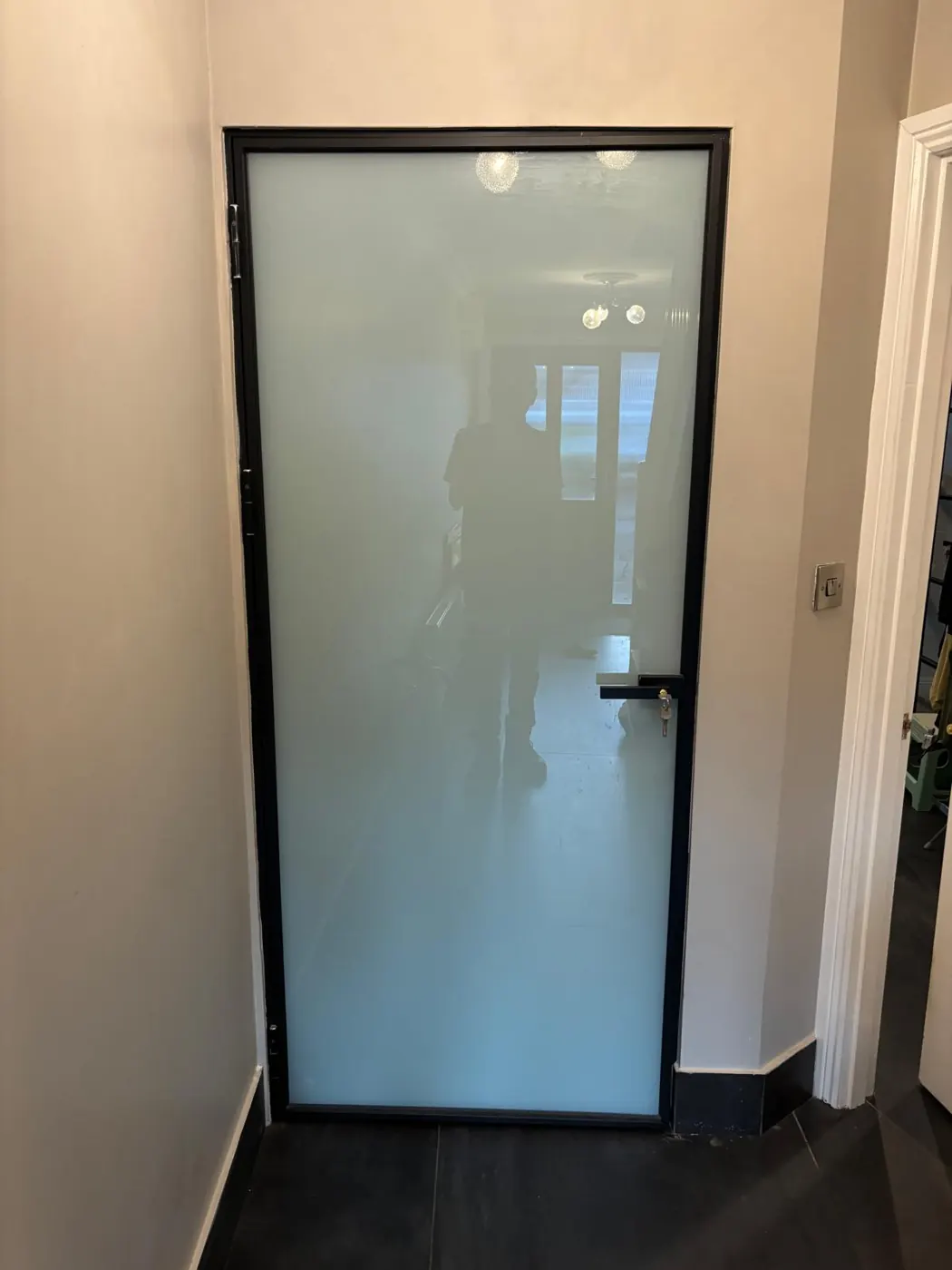
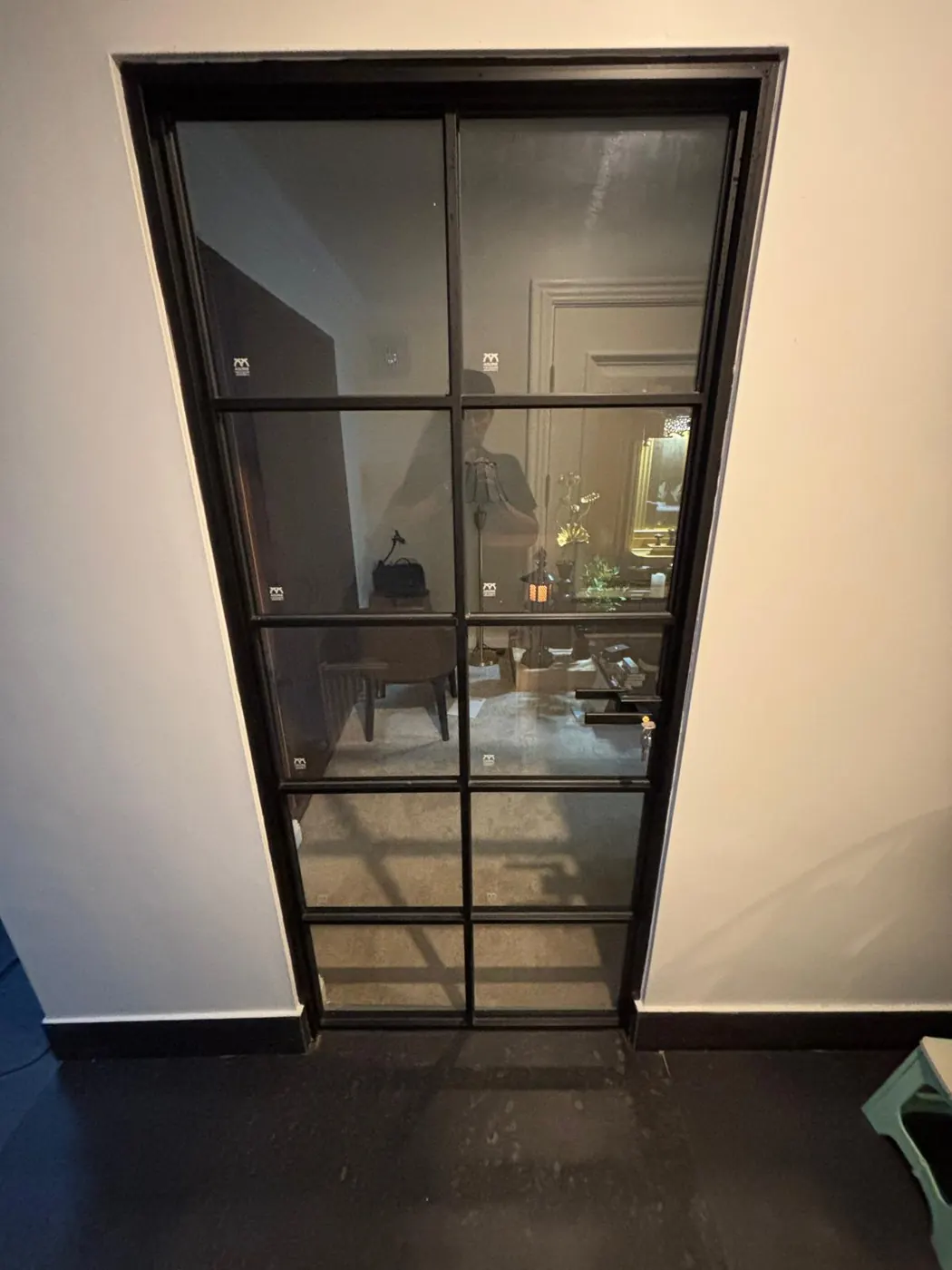
Internal doors with glass are the fastest-growing request we get. A glazed door between a hallway and a kitchen, or a living room and a dark corridor, moves natural light through the house without taking the wall down. Slim black-framed glazed doors, like the ones in the photos on this page, have become the signature choice for Dublin renovations. Frosted or reeded glass keeps privacy where you need it, clear glass where you do not. Our glass internal doors page goes through each glass option, where it belongs and what to ask before you buy.
Oak internal doors remain the classic choice for houses with timber floors and stairs, and painted doors are the most flexible, because you can match them to skirting, walls and the doors you are fitting in the kitchen at the same time.
Still weighing up which style suits your house? We wrote a plain guide to choosing internal doors for Irish homes that goes room by room.
What is the difference between hollow core, semi-solid and solid core doors?
Hollow core doors are light and poor at blocking sound. Semi-solid doors are heavier and quieter. Solid core doors are heaviest, quietest and most durable.
The core is the part of the door you never see, and it decides how the door feels every day. Hollow core doors have a thin skin over a honeycomb cardboard core, which makes them light and low-cost but more prone to dents and punctures, with little sound insulation. They suit a spare room or a hot press, not a bedroom or bathroom.
Semi-solid doors have a denser core and feel sturdier, balancing weight, soundproofing and price. For most Dublin family homes this is the sensible middle ground, and it is usually what we recommend for bedrooms.
Solid core doors reduce noise the most and feel solid when closed, and their thicker material also improves sound and heat insulation between rooms. They are the right choice for bathrooms, home offices and any room where privacy matters. They are heavier to hang, which is one reason a solid core door should be fitted by someone who hangs them every week.
Are internal doors a standard size in Ireland?
The common Irish standard is 1981mm by 762mm, but older homes vary in height, width and thickness, so we measure every doorway individually.
There is a standard, and most doors in a modern Irish house match it. Internal doors in Ireland are typically 1981mm high and around 762mm wide, with heights stepping up to 2032mm on wider doors. Thickness is usually 44mm on current doors, and thinner doors are normally found in older homes.
The catch is the word "typically". A 1950s corporation house in Crumlin, a Victorian terrace in Phibsborough and a 2005 estate house in Lucan can all have different openings, and the same house can have two different sizes upstairs and down. Measuring every opening before ordering matters most when replacing doors in an older property. That is why the free measure is the first step and not an optional extra: we check each doorway for height, width, thickness and square, and the doors are ordered to suit. Our doors are made to order, so an opening that is not a standard size can still get a door made to fit it. Our guide to internal door sizes in Ireland lists the standard sizes and how to measure.
One question we are asked at almost every measure: do door sizes include the frame? No. The quoted size, 1981mm by 762mm for example, is the door leaf only. The structural opening in the wall is larger to allow for the frame, and the frame itself takes up part of that. That is why a tape measure across the old door tells you the leaf size, but only a measure of the opening tells you whether the frame can stay.
One team for the doors and the whole renovation
Most people replacing their internal doors are not only replacing their internal doors. The doors are part of a bigger job: a new kitchen, new windows, wardrobes in the bedrooms, a media wall in the living room. Normally that means four contractors, four quotes, four schedules and four people blaming each other when the skirting meets the door frame.
The Home Upgrade Co is one contractor for all of it. The same visit that measures your doors can measure for kitchens in Dublin, for windows supplied and fitted by the same team, for fitted wardrobes and for media walls and fitted furniture. One 3D design, one quote, one schedule, one 12-week timeline, and one number to ring. No other company in Dublin offers all five services together.
If doors are the only job, that is fine too, as long as the order is 5 doors or more. Most door jobs are the whole house or a full floor, and every job is priced on its own.
Frequently asked questions
Is there a minimum order for windows and doors?
Yes. The minimum order is 5 windows or doors, in any mix: 5 windows, 5 doors, or 3 doors and 2 windows. We do not quote for one or two on their own, because the freight alone would cost more than the door or window.
How long does fitting internal doors take?
Most houses are fitted in a matter of days rather than weeks, depending on door count and whether frames are being replaced. The full process runs from free measure to installation within 12 weeks of sign-off.
Do you cover Meath, Kildare and Wicklow?
Yes, we fit internal doors in Meath, Kildare and Wicklow as well as across Dublin. The free in-home measure and quote works the same way wherever you are in our service area.
Can I supply my own doors for you to fit?
Our quotes are for doors we supply and fit together, because we can then stand over the sizing, the fit and the finish. If you already have doors, send us the details on WhatsApp and we will tell you honestly whether we can help.
Do you fit handles, latches and locks as part of the job?
Yes, handles, latches, hinges and locks are fitted as part of the job and listed on your quote. You choose the hardware style at the design stage so it matches the doors and the rest of the home.
- Pocket doors, supplied and fitted: A door that slides into the wall instead of swinging into the room.
- Sliding internal doors, supplied and fitted: Track mounted doors that slide across the wall rather than swinging into the room.
- Oak internal doors, supplied and fitted: Solid and veneered oak doors, hung and finished by our own team.
- White and painted internal doors: The default upgrade, and the one that suits the most houses.
- Internal french and double doors: A pair of doors on a wide opening, glazed or solid.
- Shaker internal doors: A framed panel door that suits period and modern Irish houses equally.