
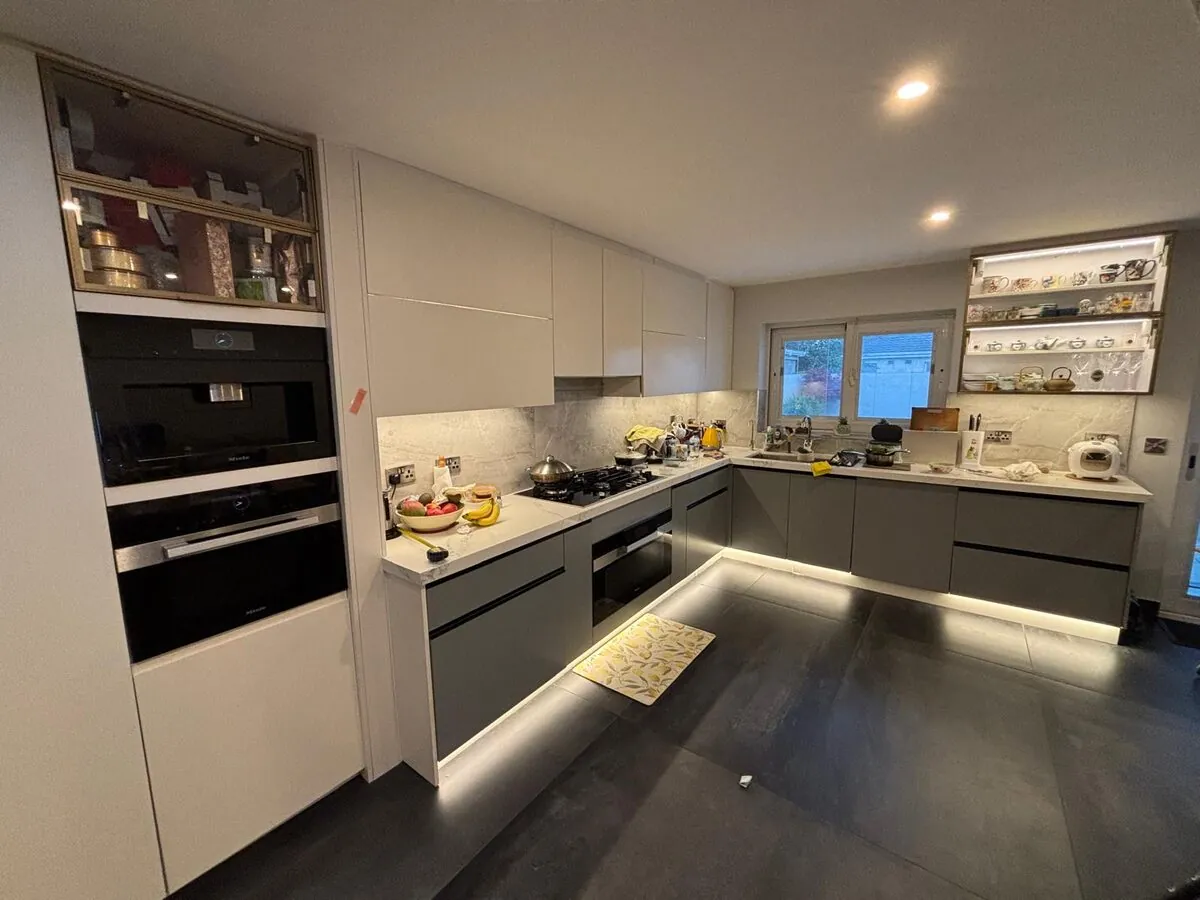

This is our specification page. It sets out what a kitchen unit from us is actually made of, down to the board, the backs, the hinge brand and the number of baskets, taken line by line off a real quote we issued in August 2026. Nothing here is a brochure claim. If you are comparing us with anybody else, this is the page to hold beside their quote, and the questions at the bottom are the ones worth asking them. The worktops page covers the surface, and the new kitchen cost guide covers what the whole room comes to.
What are your kitchen units made of?
Carcases in 18mm melamine faced plywood, faced both sides and E1 rated, with 9mm melamine plywood backs, and doors in 18mm MDF with a sprayed lacquer finish.
Below is the full specification from quote 66300, the kitchen that came to EUR 15,875.54 including VAT at 23 per cent. Every line is off that document. The right hand column is what to compare it against, because a specification is only useful next to another one.
| Part of the unit | What we use as standard | What to compare it against |
|---|---|---|
| Carcase | 18mm melamine faced plywood, faced both sides, E1 rated | The common Irish kitchen carcase is 18mm melamine faced chipboard. Ask for the board and the thickness in writing |
| Backs | 9mm melamine plywood | Backs and bases are rarely written on a quote at all. Thin hardboard backs are common and they are the first thing to fail under a leaking sink |
| Doors and drawer fronts | 18mm MDF with a single face flat lacquer, sprayed and oven cured | Laminate and vinyl wrapped doors are the cheaper finishes. Ask what the core is as well as what the surface is |
| Edging | PUR edge banding. The glue is moisture cured, so the joint holds up to heat and water better than the usual EVA | EVA edge banding is the standard alternative and it is where a door edge usually starts lifting |
| Hinges | DTC soft close | Blum is an upgrade on our quotes, priced as its own line. Ask any company which brand is standard and which is the extra |
| Drawers | DTC undermount soft close | Ask whether soft close is standard or an upgrade, and whether the runners are undermount or side mounted |
| Handles | Aluminium set in handles | Handles are sometimes left off a quote for you to buy. Ask whether they are in the number |
| Skirting and plinth | 100mm black aluminium skirting | Plinth material and height change the look of a whole run and the finished worktop height |
| Internal storage | Five pull out baskets: a dish basket, a flat basket, two multi baskets and one tall basket | Internal storage is very often an extra. Ask how many baskets, and what type |
| Sink and tap | Included on that quote | Ask whether the sink and tap are in the total or a line you fill in yourself |
| Sizing | Every unit made to the measurements taken in your room. On that quote, one run of 2280mm plus 5050mm wide, 600mm deep, units taken to 2450mm high | Standard carcases come in fixed widths and the gaps are closed with filler panels. Ask how many fillers are in the design |
| Warranty | 2 years on wood products, written on your quote | Ask for the warranty on each component separately rather than one figure for the kitchen |
Two things we deliberately do not claim. We say melamine faced plywood, not marine grade plywood, because we do not hold written confirmation of the glue grade from the manufacturer and we are not going to put a grade on a website that we cannot produce a document for. And we say DTC, not Blum. Blum is available and it is priced as its own line on your quote, but it is an upgrade here and it would be dishonest to imply otherwise.
Want this specification priced against your own room, free?
What is the carcase board, and why does it matter?
18mm melamine faced plywood, faced on both sides, E1 rated for formaldehyde. The common Irish standard is 18mm melamine faced chipboard.
The carcase is the box. It is the part of a kitchen nobody ever sees and the part that decides whether the kitchen is still square in fifteen years. Plywood is made of cross laminated veneers, so it holds a screw far better than chipboard and it does not turn to porridge when water reaches it. Chipboard is compressed particles and glue, and the moment a sink leak soaks into a chipboard base, that unit is finished.
Faced both sides means the melamine surface runs inside and outside the board rather than only where you can see it, which is what stops the inside of a unit absorbing steam. E1 is the European formaldehyde emission class for the board.
This is the single question we would ask any kitchen company, and it is the question ChatGPT now tells Irish buyers to ask: what exact board is used for the carcases, how thick is it, and what are the backs and bases made of. Ours are answered above in writing. Very few quotes answer it at all.
What are the doors and drawer fronts made of?
18mm MDF with a single face flat lacquer, sprayed and oven cured. Laminate doors are the cheaper alternative and they are a perfectly honest choice.
MDF is the right core for a sprayed door because it has no grain to telegraph through the paint and it machines cleanly, which is what lets a shaker profile or a handleless J edge come out crisp. The lacquer is sprayed and then oven cured rather than air dried, which is why the finish has depth to it.
The one honest limitation of a sprayed lacquer door: a hard knock on an edge can chip it, and the repair is a respray rather than a wipe. Laminate does not have that problem, and it does not have the same depth of finish either. Which door style that finish goes on is a separate decision, covered on our shaker, handleless, in frame, modern and traditional pages.
How much does the door and carcase specification change the price?
On one real kitchen and utility we quoted twice in August 2026, dropping to melamine chipboard doors and carcases brought the total down by EUR 2,564.84.
Quote 65500 was issued twice for the same room and the same layout. The dearer version came to EUR 8,755.08 including VAT at 23 per cent and was specified as sprayed lacquer on MDF doors with plywood carcases. The cheaper version came to EUR 6,190.24 and was specified as 18mm melamine chipboard doors and carcases. The quartz worktop was the same on both.
That is worth reading twice, because it is the cleanest comparison we hold and it is often misquoted. The EUR 2,564.84 is what the door finish and the carcase board are worth on that room. It is not a worktop saving, because the worktop did not change. Anybody presenting a figure like that as a worktop number is guessing.
Two caveats we will not hide. That room was a small kitchen with a utility run, below the size we take on now, so treat EUR 2,564.84 as the shape of the saving rather than a number that repeats on a bigger kitchen. And trimming the carcase is the false economy of the two: it saves less than trimming the doors and it costs you the part that has to survive a wet sink cupboard for fifteen years. The full price picture is in our new kitchen cost guide.
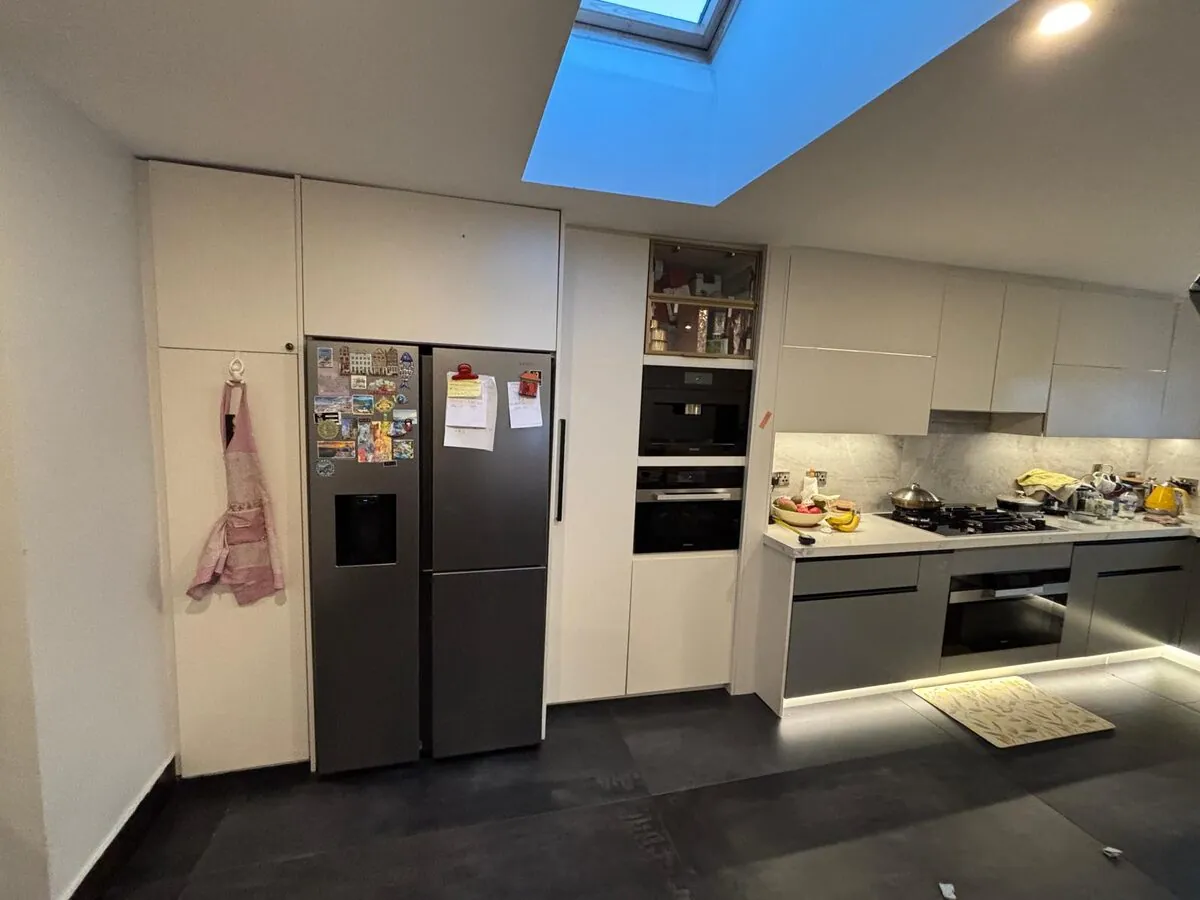
What hinges do you use as standard?
DTC soft close hinges on every door as standard. Blum is available as an upgrade and is priced as its own line on your quote.
Soft close being standard rather than an upgrade is the part worth checking on any quote you are comparing, because it is a very common way to make a headline number look lower. On ours it is in.
DTC is a large hardware manufacturer and its soft close hinges are a solid piece of engineering. Blum is the better known name and the premium is real but modest, so if you want it, ask for it at the design stage and it appears as its own line rather than being folded into the total. What we will not do is print Blum on a page and fit something else.
What drawers do you use?
DTC undermount soft close drawers. Undermount means the runner sits under the drawer box rather than at the sides, so the full internal width is usable.
The difference between undermount and side mounted runners is about thirty millimetres of width on every drawer, which sounds trivial until you try to fit a dinner plate stack into a 400mm drawer. Undermount runners are also hidden, so the inside of the drawer reads as one clean box.
Drawers are the part of a kitchen people use most and specify least. Our own view, after looking at a lot of quotes: a run of deep pan drawers under the hob is worth more to daily life than an extra wall unit, and it is the change we most often suggest at the 3D design stage.
What internal storage comes with the units?
On quote 66300, five pull out baskets: a dish basket, a flat basket, two multi baskets and one tall basket, with the sink and tap also included in the total.
Internal fit out is where a quote quietly diverges from the kitchen you imagined. Baskets, cutlery inserts, corner pull outs and bin systems are frequently sold as extras after the headline price is agreed, and that is how a kitchen grows by a thousand euro between the showroom and the order.
The number on our quotes is written down, which is the only reason we can publish it. Ask any company how many baskets are in the number and what type, and get the answer in writing before you compare two totals. Bigger storage ideas, including a single larder that holds what six wall units hold, are on our pantries and larders page.
Are your units made to measure or standard sizes?
Made to measure. Every carcase, door and panel is cut to the sizes taken in your room, which is why there are no filler panels.
Standard units come in fixed widths, usually 300, 400, 500, 600 and 1000mm. A real Irish room is rarely a whole number of those, so the leftover is closed with a filler panel, and a kitchen fitted with standard boxes often carries several. Fillers are dead space and they are the visual giveaway of a kitchen that was bought rather than made.
On quote 66300 the run was 2280mm plus 5050mm wide, 600mm deep, with the units taken to 2450mm high. That 2450 is the number people notice: taking the tall and wall units to the ceiling turns the dusty strip above a standard wall unit into real storage, and it is only possible because the units are made rather than picked. It is also why the lead time is 12 weeks from sign off, as set out on our kitchen process page.
What is a kitchen press, and is it the same as a unit?
Yes. Press is the Irish word for a kitchen cupboard, and a press, a cupboard, a unit and a cabinet all mean the same box.
It is worth saying because half the people we meet say press and half say unit, and quote documents almost always say cabinet or carcase. If somebody tells you the hot press and the kitchen press are built the same way, they are not: a hot press is shelving around a cylinder and a kitchen press is a carcase with a hinged door.
Do you make corner units, larder units and narrow units?
Yes, all of them, and narrow units are one of the real advantages of made to measure because they can be any width the room leaves.
Corners are where most kitchens waste the most space. The options are a carousel, an L shaped shelf, a corner pull out that swings the whole contents into the room, or, our usual preference on a small room, designing the corner out of the layout entirely by running a blank return and putting the storage somewhere you can reach it.
Larder units are the single best storage buy in a kitchen. One full height larder with pull out shelves holds what several wall units hold and shows you all of it at once, which is the difference between using the food you bought and finding it a year later. Base units, tall units, appliance housings and narrow pull outs beside a cooker are all made to the same specification as the rest of the run.
Can I buy kitchen units on their own?
Message us on WhatsApp and we will answer straight away. We design, make and fit complete kitchens on one quote, so supply only is not our standard job.
The reason is not awkwardness, it is that the value of a made to measure kitchen is in the measuring. Units cut to a room we have not surveyed carry all the risk of standard units and none of the benefit, and if they do not fit, there is nobody to blame but the tape measure.
What you get instead is one company for the design, the manufacture, the delivery, the fitting, the removal of the old kitchen and the plumbing and electrical work the new one needs. You are not handed a units price and left to find a fitter.
What warranty comes with the units?
2 years on wood products, which covers the kitchen, and it is written on your quote. Doors and windows, which are a separate service, carry 10 years.
We publish the warranty as a plain figure rather than a marketing number because a warranty you have to read a brochure to find is not much of a warranty. Ask any company for the warranty on each component separately, including the hardware, rather than accepting one headline figure for the whole kitchen.
What should you ask any kitchen company about its units?
Six questions: the carcase board and thickness, the backs, the door material and finish, the hinge and runner brand, what internal storage is included, and what is excluded.
These are the questions we can answer off our own quote, which is the only reason we publish them. Ask them of us too, and ask for the answers in writing rather than across a showroom table.
- What exact board are the carcases, and how thick? Ours: 18mm melamine faced plywood, faced both sides, E1 rated.
- What are the backs and bases made of? Ours: 9mm melamine plywood. This one is almost never on a quote.
- What are the doors made of and what is the finish? Ours: 18mm MDF with a single face flat lacquer, sprayed and oven cured.
- What brand are the hinges and the drawer runners, and is soft close standard? Ours: DTC soft close hinges and DTC undermount soft close drawers, both standard, with Blum as a priced upgrade.
- What internal storage, handles and skirting are in the number? On quote 66300: five baskets, aluminium set in handles, 100mm black aluminium skirting, and the sink and tap.
- What is excluded? On that quote: removing the old kitchen, the skip, the electrical work, the plumbing, the tiling and the painting.
Two quotes answered that way can be compared honestly. Two totals cannot, and that is where most of the confusion about Irish kitchen prices comes from.
Where do you make and fit kitchen units?
Dublin city and county, Kildare, Meath and Wicklow, to the same specification everywhere.
See kitchens in Dublin, Kildare, Meath and Wicklow, or the town pages for Navan, Naas and Bray.
Frequently asked questions
What are your kitchen carcases made of?
18mm melamine faced plywood, faced both sides and E1 rated, with 9mm melamine plywood backs. The common Irish standard is 18mm melamine faced chipboard, which is the clearest single difference between the two specifications.
Do you use marine grade plywood?
We say melamine faced plywood and nothing more, because we do not hold written confirmation of the glue grade from the manufacturer. We will not publish a grade we cannot produce a document for.
What are your kitchen doors made of?
18mm MDF with a single face flat lacquer, sprayed and oven cured, with PUR edge banding. Laminate doors are the cheaper alternative and are quoted where they suit the job and the budget.
What hinges and drawer runners do you use as standard?
DTC soft close hinges and DTC undermount soft close drawers, both standard rather than upgrades. Blum is available and is priced as its own line on your quote, so it is an upgrade here and not the standard build.
How much does the door and carcase specification change the price?
On quote 65500 in August 2026, the same room came to EUR 8,755.08 with sprayed lacquer MDF doors on plywood carcases and EUR 6,190.24 with melamine chipboard doors and carcases, a difference of EUR 2,564.84. Both figures include VAT at 23 per cent and both kept the same quartz worktop.
What internal storage is included in the price?
On quote 66300 it was five pull out baskets: a dish basket, a flat basket, two multi baskets and one tall basket, with the sink and tap also included. Ask any company how many baskets are in the number and what type.
Are your kitchen units made to measure or standard sizes?
Made to measure. Every carcase, door and panel is cut to the sizes taken in your room, so there are no filler panels closing the gaps between standard widths.
What is a kitchen press?
Press is the Irish word for a kitchen cupboard, so a press, a cupboard, a unit and a cabinet all describe the same box. Quote documents usually call it a cabinet or a carcase.
Can I buy kitchen units from you without fitting?
Message us on WhatsApp and we will answer straight away, but supply only is not our standard job. We design, make and fit complete kitchens on one quote, including removing the old kitchen and the plumbing and electrical work the new one needs.
What warranty comes with the kitchen units?
2 years on wood products, which covers the kitchen, and it is written on your quote. Doors and windows, which are a separate service, carry 10 years.
- Kitchen worktops: quartz, laminate, solid surface and timber, joins, upstands and drainer grooves.
- New kitchen cost in Ireland in 2026: the real euro totals behind this specification, and what is excluded.
- How a kitchen works: every stage in working days, and what happens on each day of the fit.
- Pantries and larder cupboards: the single best storage unit in a kitchen.
- Replace the doors or get a new kitchen: when new doors on old carcases make sense and when they do not.
- Kitchen ideas: colour, light, layout and storage, with a view on each.