
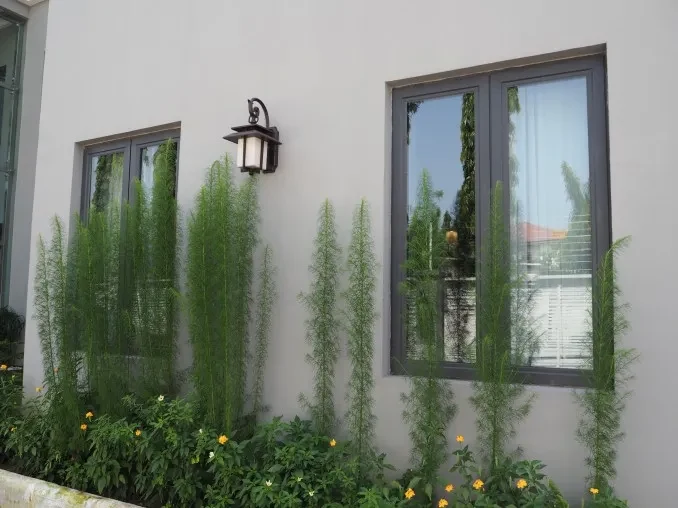

Aluminium is the choice when you want the frame to disappear. It is strong enough to hold a large pane in a slim section, which is why it turns up on extensions, rear elevations and anywhere the view is the point. It costs more than uPVC, and the reason to pay it is almost always the sightline.
What do you actually get for the extra cost?
Slimmer frames, larger panes and a harder wearing finish. Mostly you are paying for glass area and a thinner frame around it.
Aluminium is far stronger than uPVC for the same section, so the frame can be much slimmer while carrying a bigger unit. On a large opening that is a visible difference: more glass, less frame, and a cleaner line.
The powder coated finish is also more durable than a uPVC surface and holds a colour, including dark colours, without the fading that dark uPVC can show over time.
What does thermally broken mean, and does it matter?
It means an insulating barrier is built into the middle of the frame so heat cannot pass straight through the metal. It matters a great deal.
Aluminium conducts heat readily, which would make an un broken aluminium frame a cold bridge straight through your wall, with condensation on the inside face in winter. The thermal break interrupts that path.
Any aluminium window worth fitting in an Irish house is thermally broken. It is worth confirming it is specified rather than assuming.
Where does aluminium make sense, and where does it not?
It makes sense on large openings and modern elevations. On standard sized windows in a typical estate house, uPVC usually gives you the same performance for less.
The slim frame advantage only shows up when there is a lot of glass to frame. On a small bedroom window the difference is marginal and hard to justify.
A common approach is to mix: aluminium on the big rear opening where the sightline matters, uPVC elsewhere. There is nothing wrong with that, and it puts the money where it shows. Our <a href="/windows/upvc/">uPVC windows</a> page covers the alternative.
Does aluminium need any maintenance?
Very little. Wash the frames occasionally, and keep the drainage slots clear.
Powder coated aluminium does not need painting and does not corrode in normal use. Near the coast, where salt is in the air, rinsing the frames a few times a year is worth doing.
The drainage slots along the bottom of the frame matter more than people realise. They let water that gets past the seal drain out again, and blocking them with dirt is what causes water to sit and eventually find its way inside.
Windows carry a ten year warranty against defects.
How it works
We call out, measure the space and talk through what you want. Our designers draw it in 3D so you see the finished piece in your own room, and you get one complete itemised quote within two working days. Nothing is ordered and nothing is charged until you say yes.
One team for this and the rest of the job
The same team that makes this fits it, and we also do kitchens, fitted wardrobes, internal doors and windows. If more than one thing needs doing, it is one contractor, one schedule and one point of contact rather than four. See the rest of our work.
Frequently asked questions
Can you do aluminium in any colour?
Powder coating covers a wide range of standard colours, including the anthracite grey and black that most people ask for. Colours are confirmed at the design visit.
Can I have aluminium at the back and uPVC at the front?
Yes, and it is a sensible way to spend the budget where it shows. We will price both on the same quote.
Are aluminium windows colder than uPVC?
A thermally broken aluminium frame performs well. An aluminium frame without a thermal break would be, which is why we only fit thermally broken units.
What areas do you cover?
Dublin, Meath, Kildare and Wicklow. The design visit is free and there is no obligation.