
This is the route a house extension takes through planning in Ireland, from the first drawings to the day the builder can start. The rules below are the ones in force on 27 October 2026. Applications are still made under the Planning and Development Act 2000 and the 2001 Regulations; the Department of Housing says the rest of the Planning and Development Act 2024 will start in the coming weeks, and its draft regulations keep the same fees, notice periods and map scales. We will update this page when that happens.
Step 1: Getting extension drawings done by a designer
Floor plans, elevations and sections at a scale of at least 1:200, a site layout plan at 1:500, and a site location map on Ordnance Survey mapping.
The planning regulations set what the drawings must show, not who draws them, but most homeowners use an architect, an architectural technologist or a chartered engineer. Before anything is drawn, check whether the extension needs permission at all: a rear extension of up to 45 square metres is often exempt. Our guide to when an extension needs planning permission sets out the conditions.
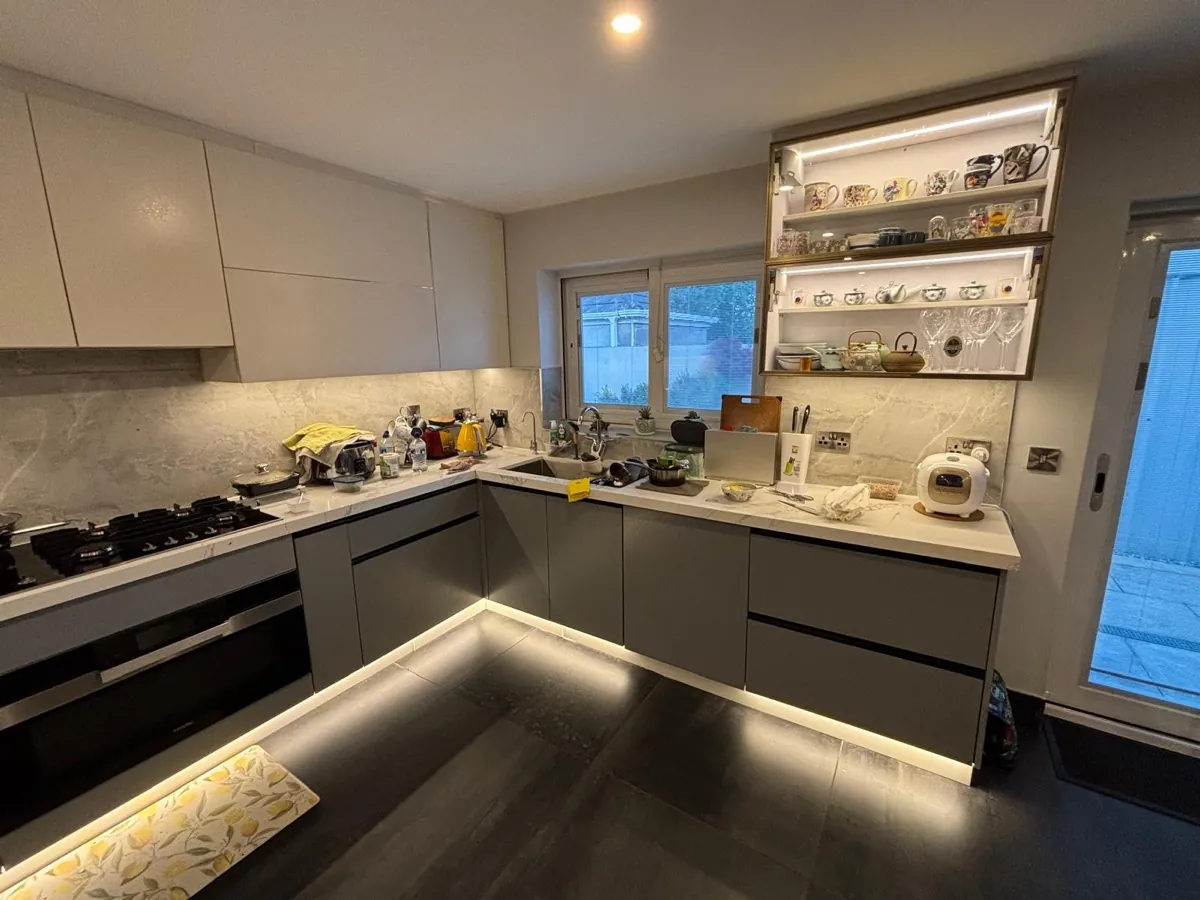
This is also the best moment to decide the kitchen and the windows. The kitchen layout fixes where the sockets, water and waste go, and the window sizes go on the elevations the council sees.
Step 2: The site notice and newspaper notice
Both go up within the 2 weeks before you lodge the application. The site notice stays up for 5 weeks after the council receives it.
- Newspaper notice: in a newspaper on your council's approved list. Each council approves its own list, and it can differ between parts of a county.
- Site notice: on or near the entrance from the public road, easily read from the road, in indelible ink on rigid, weatherproof material. It is white, or yellow if you apply again on substantially the same site within 6 months of an earlier application.
Step 3: Lodging your planning application online
Online through the Local Government Ireland planning portal, which every council except Cork City accepts, or on paper to the council.
You create an account on planning.localgov.ie and upload the pack. A complete pack for an extension contains:
- the council's application form
- the page of the newspaper with the notice, and a copy of the site notice
- a site location map on Ordnance Survey mapping, at least 1:1000 in built up areas or 1:2500 elsewhere, with the site outlined in red and the site notice position marked
- a site layout plan at least 1:500, showing boundaries, buildings and services
- floor plans, elevations and sections at least 1:200, with a schedule of the drawings
- a letter of consent from the owner, if you do not own the property
- the fee, €34 for a house extension
An incomplete pack is returned as invalid and the clock never starts, so this list is worth ticking off with your designer. It is in the free Extension Planner too.
Step 4: Public submissions and observations
For 5 weeks from the day the council receives the application, anyone can make a written submission for a fee of €20.
Submissions can support or object. The planner reads them before deciding, and apart from you as the applicant, it is generally only people who made one who can appeal the decision later. Each council's online register shows the submissions on a file; our council guides for Dublin City Council, South Dublin, Fingal, Dún Laoghaire-Rathdown, Kildare, Meath, Wicklow and Louth explain how to find them.
Step 5: The council decision and further information requests
The council must decide within 8 weeks. It can stop the clock, inside those 8 weeks, to ask for further information.
A further information request is common and is not a refusal. Once you reply, the council has 4 weeks to decide. If you do not reply within 6 months of the request, the application is treated as withdrawn. If the information is significant, the council can ask for new notices, and the public can comment again.
Step 6: Appeals to An Coimisiún Pleanála
There are 4 weeks from the date of the council's decision to appeal. An appeal costs €220.
An Coimisiún Pleanála replaced An Bord Pleanála on 18 June 2025, and is still at pleanala.ie. You can appeal a refusal or a condition. A neighbour who made a submission can appeal a grant, also for €220. An appeal on a retention application is €660, and an observation on someone else's appeal is €50. Appeals can be made online or by post or hand delivery, not by email.
Step 7: Planning conditions, the grant and the commencement notice
The grant issues after the 4 week appeal period with no appeal. Then a commencement notice goes in 14 to 28 days before building starts.
- Conditions: read every condition on the grant before work starts, and check with your designer which ones need action first.
- Commencement notice: filed online on the Building Control Management System, not less than 14 and not more than 28 days before work starts. It is needed for an extension that required planning permission and for any extension over 45 square metres. An exempt extension does not need one, but it still has to meet the Building Regulations.
- Over 45 square metres: the statutory certification applies (a design certifier, an assigned certifier and the builder's undertaking), unless you as the owner lodge a declaration to opt out of it.
- How long it lasts: normally 5 years, and since 20 July 2026 you can apply to extend it up to 2 years before it expires.
How long planning permission takes in Ireland
| Stage | How long |
|---|---|
| Notices up before lodging | Within 2 weeks before the application goes in |
| Public submissions | 5 weeks from the day the council receives it |
| Council decision | Within 8 weeks of receiving it |
| Further information, if asked | You have 6 months to reply; the council then has 4 weeks |
| Appeal period | 4 weeks from the decision |
| Commencement notice | 14 to 28 days before work starts |
| Permission lasts | Normally 5 years |
With no further information and no appeal, that is about 14 weeks from notices to grant, plus at least 14 days for the commencement notice.
Where the kitchen, windows and wardrobes fit in your extension timeline
Our kitchens and windows take about 12 weeks from signing off the design to fitted. The windows close the house in, so they are ordered first. The kitchen goes in after plastering, and wardrobes and fitted furniture usually last. Having the fit out designed and priced while the application is with the council means nothing holds the builder up later. The free plan check gets it priced from your drawings.
Planning process questions from Dublin, Kildare, Meath and Wicklow
How long does planning permission take in Ireland?
The council must decide within 8 weeks of receiving a valid application. Allow about 2 weeks before that for the notices, and 4 weeks after the decision for the appeal period, so about 14 weeks in all if there is no further information request and no appeal.
What happens if the council asks for further information?
The 8 week clock stops. Once you reply, the council has 4 weeks to decide. If you do not reply within 6 months of the request, the application is treated as withdrawn. If the new information is significant, the council can ask you to put up new notices, and people can comment again.
Can my neighbour object to my extension?
Yes. Anyone can make a written submission or observation on a planning application within 5 weeks of the council receiving it, for a fee of €20. Apart from the applicant, it is generally only people who made a submission who can appeal the council's decision later.
How much does it cost to apply for planning permission?
The council fee for a house extension is €34, whatever the size. Retention permission for an extension costs €102 or €2.50 per square metre, whichever is more. An appeal to An Coimisiún Pleanála costs €220. The drawings and professional time cost far more than the fees, and are priced job by job.
Can I start building as soon as the council says yes?
No. The council's decision to grant is a notice of intention. The grant itself issues once the 4 week appeal period passes with no appeal. Then you need to lodge a commencement notice 14 to 28 days before work starts.
How long does planning permission last?
Normally 5 years. Since 20 July 2026, you can apply to extend it up to 2 years before it runs out, where it used to be 1 year.
Sources for this guide
Every figure and rule on this page was checked against these official sources on 27 October 2026. Planning law is changing under the Planning and Development Act 2024, so check the source before you rely on a detail.
- Citizens Information: Planning permission last checked 27 October 2026
- Planning and Development Regulations 2001 (S.I. No. 600 of 2001) last checked 27 October 2026
- Planning and Development Act 2000, section 34 (revised) last checked 27 October 2026
- Citizens Information: Appealing a planning decision last checked 27 October 2026
- An Coimisiún Pleanála: who we are last checked 27 October 2026
- An Coimisiún Pleanála: appeal fees last checked 27 October 2026
- Local Government Ireland Online Planning portal last checked 27 October 2026
- Building Control Regulations 1997, article 7 (revised) last checked 27 October 2026
- Building Control Regulations 1997, article 8 (revised) last checked 27 October 2026
- Building Control Regulations 1997, article 9 (revised) last checked 27 October 2026
- S.I. No. 359 of 2026: Building Control threshold of 45 square metres last checked 27 October 2026
- S.I. No. 330 of 2026: extending the duration of a permission last checked 27 October 2026
- National Building Control Office: BCMS last checked 27 October 2026
- gov.ie: Planning and Development Act 2024 commencement last checked 27 October 2026